
Supporting families with the cost of early childhood

Supporting families with the cost of early childhood
The early years of a child’s life bring celebration of milestones, fear and anxiety, moments of joy, exhaustion – and substantial costs for parents. The C.S. Mott Children’s Hospital National Poll on Children’s Health asked a national sample of parents with children age 0-18 about the financial demands of raising young children.
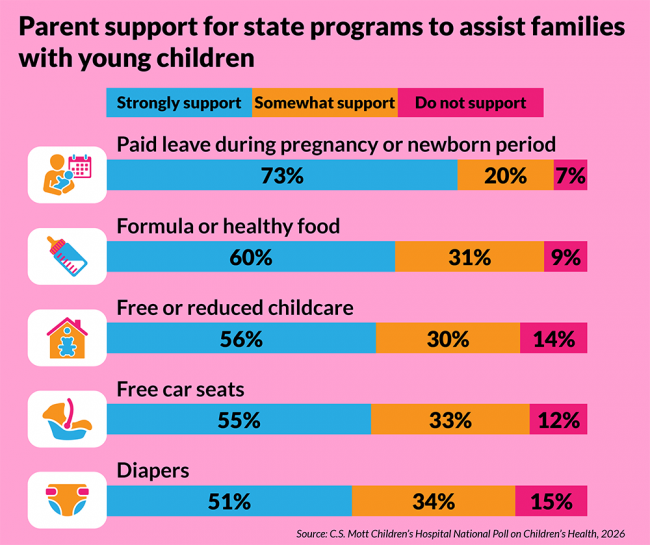
Across all parents, 96% agree that a baby’s early development is important to long-term health, and 81% agree that having a baby is more expensive than it should be; yet only 59% agree that supporting families with young children is a good use of taxpayer dollars. Parents say they would strongly support programs in their state that provide families with paid leave during pregnancy or the newborn period (73%), formula or healthy food (60%), free or reduced childcare (56%), free car seats (55%), and diapers (51%); few would not support such programs at all (Figure). Parents of a young child 0-3 years are more likely to strongly support the programs than parents with older children 4-18 years, and more likely to say all families should quality for these programs, not just those that demonstrate financial need (58% vs 41%).
Among parents with a young child 0-3 years, 40% describe their current financial situation as struggling or just getting by vs 60% comfortable or adequate, and 37% of parents who are struggling/just getting by say they worry about finances constantly. To manage the costs of raising a young child, 68% say they got secondhand baby clothes and equipment, 58% report reduced spending on extras, and 42% have worked extra hours and saved up. Parents who are struggling/just getting by are more likely to report reducing spending on extras and having worked extra hours. Only 14% say they did not use any of these strategies.
Among parents of older children, 38% say they have donated in the past two years to a local organization or faith-based program that helps families with young children; another 20% have assisted family or friends with a young child; and 42% have made no donations. Half (51%) say they do not know which programs really provide the help young families need, while 42% prefer helping families they know personally rather than strangers. Some parents of older children believe that people who can’t afford the costs should not have children (39%) or should look to churches and charities rather than taxpayers (32%).
Highlights
- 4 in 5 parents say having a baby is more expensive than it should be.
- Among parents of a young child 0-3 years, 2 in 5 parents describe themselves as financially struggling or just getting by.
- Among parents of older children, 2 in 5 have not donated to an organization or family with a young child, and half say they do not know which programs provide the help that young families need.
Implications
A baby’s early years set the stage for a lifetime of health and well-being. Healthy food allows the baby to grow, establishes the foundation of a healthy diet, and protects against childhood obesity. An adequate supply of diapers is needed to avoid diaper rash and urinary tract infections. High-quality childcare nurtures a child’s physical and cognitive development, putting them on the right pathway to being “ready to learn” when they enter school. Car seats, cribs, and other equipment – when in good condition and used correctly – help keep the baby safe.
With so many things to consider, it is often challenging for parents to meet the needs of a young child, particularly because the costs are substantial, and come at a time when at least one parent typically has to reduce their work hours. In this Mott Poll, among parents of young children 0-3 years, 2 in 5 described themselves as struggling or just getting by, and many of these struggling parents said they worry constantly about their family financial situation. The anxiety caused by financial pressures can exacerbate the already difficult job of parenting a young child.
This Mott Poll shows near-universal agreement that early development is important to a child’s long-term health, and general acknowledgement that having a baby is expensive, but varied opinions on the extent to which public programs are the best strategy to support families with young children. The strongest support is for state programs that mandate paid leave during the pregnancy or newborn period. This policy, which exists in some states, allows parents to take time off around the birth of a baby without substantial financial penalty. In addition, some parents have paid leave through their employer. Paid leave offers flexibility for parents; they can use those dollars for whatever their family needs.
Over half of parents express strong support for state programs that offer assistance for certain expenses: formula or healthy food, childcare, car seats, and diapers. These programs are helpful for many families, but an issue is that families may not need assistance with that aspect; for example, a family may get a secondhand car seat from a neighbor or childcare through a family member. The other challenge is that it can be time-consuming to search and apply for programs that offer assistance with different types of expenses – time that parents of young children typically do not have. In that respect, programs that provide general financial support allow parents to use those dollars to meet their family’s greatest needs. In a similar vein, programs that serve all families, rather than limiting it to those who meet financial qualifications, offer an easier pathway to participation.
Some parents in this Mott Poll, particularly those with older children, have a more skeptical view of using public programs to alleviate the costs of having a young child. They may not understand how much costs have increased since their own children were young. In addition, they may not realize that this current group of parents of young children are using multiple strategies to deal with those costs: working extra hours, cutting out extras, getting secondhand clothes and equipment.
One-third of parents of older children felt that parents of young children should look to churches and charities for assistance, rather than public programs. This approach requires community members to support local organizations and faith-based programs that offer assistance. However, a notable finding is that half of parents with older children said they don’t know which programs provide the help that families with young children really need. Indeed, it is difficult to learn about the different organizations and programs that try to assist families with young children. This argues in favor of programs that provide parents with flexibility, such as paid parental leave or direct payments, which allow parents to use funds where they are needed.
Data Source & Methods
This report presents findings from a nationally representative household survey conducted exclusively by Ipsos Public Affairs, LLC (Ipsos) for C.S. Mott Children’s Hospital. The survey was administered in July 2026 to a randomly selected, stratified group of adults who were parents of at least one child age 0-18 years living in their household (n=2,027). Adults were selected from Ipsos’s web-enabled KnowledgePanel® that closely resembles the U.S. population. The sample was subsequently weighted to reflect population figures from the Census Bureau. The survey completion rate was 69% among panel members contacted to participate. The margin of error for results presented in this report is ± 1 to 7 percentage points.
Findings from the C.S. Mott Children’s Hospital National Poll on Children’s Health do not represent the opinions of the University of Michigan. The University of Michigan reserves all rights over this material.
Citation
Clark SJ, Beel L, Gebremariam A, Schultz SL, Woolford SJ. Supporting families with the cost of early childhood. C.S. Mott Children's Hospital National Poll on Children's Health, University of Michigan. Vol 50, Issue 3, October 2026. Available at: https://mottpoll.org/reports/supporting-families-cost-early-childhood.

