
Choice or chore? Involving children in pet care

Choice or chore? Involving children in pet care
Whether furry, feathered, or scaly, family pets need regular care; involving children in pet care can bring challenges. The C.S. Mott Children’s Hospital National Poll on Children’s Health asked a national sample of parents with children age 6-12 about their attitudes around children’s role in caring for family pets.
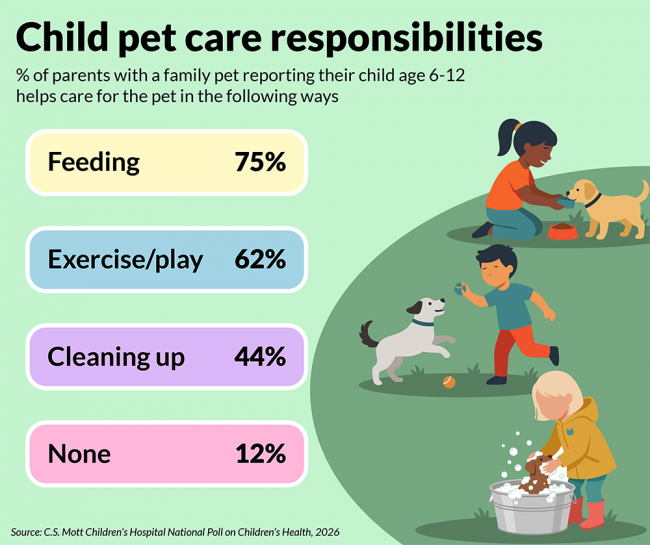
Most parents agree that pets are good for children’s emotional health (77%). Nearly two-thirds of parents (63%) report currently having a family pet, while 10% had one in the past three years and 27% have not. Among families with a pet currently, parents say their child helps with feeding (75%), exercise or play (62%), or cleaning up after the pet (44%); 12% say their child does not help with any of these tasks. Among children with pet-care responsibilities, parents expect their child to help daily (48%), a few times a week (30%), or when asked (22%). Most parents describe helping with the pet as simply part of being a family member (65%), rather than a part of regular chores (21%), something required to earn an allowance (7%), or an occasional task (7%).
Most parents report that their children follow through with these responsibilities. Among parents whose child has assigned pet-care duties, 45% say their child completes the assigned job almost always, 41% usually, 13% sometimes, and 1% rarely. When children do not complete their assigned tasks, most parents (80%) remind them to do it, while others report that another family member takes care of the task (32%) or the child receives a consequence, such as being grounded or losing screen time (25%).
Among families without a current pet, 70% of parents say their child has asked to get one. Parents cite several reasons for not having a family pet: it is too time-consuming (40%), too expensive (34%), they just don’t want one (28%), allergies (23%), a previous pet died and they are not ready to get another (19%), child is scared of animals (6%), or no particular reason (11%).
Overall, 79% of parents believe children age 6-12 should be expected to help take care of the family pet, while 14% say children should help only if they asked to get the pet, and 7% say children should not be expected to help. In a hypothetical situation where a child asks for a pet but fails to help with its care, even after reminders, 14% of parents say the pet should be given away to teach the child consequences, 42% feel that giving the pet away would traumatize the child, and 44% are unsure.
Highlights
- 3 in 4 parents believe pets are good for children’s emotional health.
- 4 in 5 parents think school-age children should help care for the family pet.
- Among families with pets, half assign their school-age child to daily pet care responsibilities.
- Among families with no pets, 7 in 10 say their school-age child has asked to get one.
Implications
Family pets can offer children companionship and support their emotional health. Having a pet can help children develop empathy and understand what it means to care for another living thing. The expectation for children to help with the upkeep of a family pet can teach them responsibility and follow-through. However, these positive benefits stem from reasonable expectations and appropriate parental supervision.
Most parents in this Mott Poll felt children age 6-12 should help care for the family pet, and many reported that their children have some responsibility for feeding, exercising, or cleaning up after their pet. These activities offer opportunities for school-age children to contribute to the care of the family pet in a way that is appropriate for the child’s age, maturity, and the type of pet. For example, younger children might help refill a water bowl or brush a pet, while older children could manage feeding schedules or take supervised walks. Parents should demonstrate how to complete these tasks and explain why they are important for the pet’s well-being.
There is a difference between giving a child the choice of helping with pet care and assigning pet care as a chore to be done on a regular basis. When considering whether their child should be assigned a pet care task as a chore, parents should be realistic about the time burden of the task (how long it takes and how often it needs to be done), whether the pet is cooperative during the task, and the child’s ability to complete the task independently. Decisions about a child’s involvement in pet care should also consider what the parents will do if the child cannot or will not complete their assigned pet care tasks. In many families, there are consequences when children do not do their chores, such as a loss of privileges. This approach can be applied to pet care chores, but parents should exercise caution: making pet care a negative experience may counteract the positive benefits of having a pet.
Whether by choice or chore, parents play an important role in fostering their child’s success at pet care. An important aspect is to build the pet care task into the child’s regular routine; for example, the child may feed the pet each morning right after they finish their own breakfast. Leaving pet care to chance increases the risk that a hectic morning or busy schedule will interfere with the child fulfilling their responsibilities. If a child is unable or unwilling to follow through, parents must step in to ensure the pet receives the care it needs. Parents can offer additional support, such as a sticker chart or other reward system, to help the child become more consistent, or modify the pet care task to allow the child to have a positive, successful experience.
For families without pets, the decision to get one may be complicated by children’s enthusiasm. Most parents without a current pet say their child has asked for one, but many cite concerns about the time and expense involved. Before bringing a pet into the household, families should consider the ongoing commitment, including feeding, exercise, cleaning, veterinary care, and other expenses. A child’s excitement about a new pet may fade, but the responsibility of caring for that animal continues. Families who are not ready for pet ownership might consider other opportunities for children to interact with animals, such as helping a neighbor or relative care for a pet.
Animal shelters often receive animals from families that got a pet, often as a gift for a child, and then decided it was not a good fit. Parents in this Mott Poll were divided on whether a pet should be given away if a child who asked for it repeatedly fails to help with its care. While some viewed this as a way to teach consequences, others thought it would be traumatic. Families can avoid this situation by taking time to learn about different pet options and selecting one that matches their child’s level of interest and time for pet care. If a family is unable to provide adequate care, rehoming may be a responsible choice.
Pet ownership can be a valuable way for children to learn responsibility, but it remains a family commitment. With age-appropriate expectations and consistent guidance, families can turn everyday pet care into lasting lessons about dependability and compassion while ensuring their pet receives the care it needs.
Data Source & Methods
This report presents findings from a nationally representative household survey conducted exclusively by Ipsos Public Affairs, LLC (Ipsos) for C.S. Mott Children’s Hospital. The survey was administered in July 2026 to a randomly selected, stratified group of adults who were parents of at least one child age 0-18 years living in their household (n=2,027). Adults were selected from Ipsos’s web-enabled KnowledgePanel® that closely resembles the U.S. population. The sample was subsequently weighted to reflect population figures from the Census Bureau. The survey completion rate was 69% among panel members contacted to participate. This report is based on responses from 1,037 parents with at least one child age 6-12 The margin of error for results presented in this report is ±1 to 5 percentage points.
Findings from the C.S. Mott Children’s Hospital National Poll on Children’s Health do not represent the opinions of the University of Michigan. The University of Michigan reserves all rights over this material.
Citation
Clark SJ, Beel L, Schultz SL, Gebremariam A, Woolford SJ. Choice or chore? Involving children in pet care. C.S. Mott Children's Hospital National Poll on Children's Health, University of Michigan. Vol 50, Issue 4, November 2026. Available at: https://mottpoll.org/reports/choice-or-chore-involving-children-pet-care.
