
E-bikes: Unsafe or uncertain?

E-bikes: Unsafe or uncertain?
Electric bicycles, also known as e-bikes, offer teens and pre-teens a new option for transportation and recreation. Different classes of e-bikes range in size, weight and speed. The C.S. Mott Children’s Hospital National Poll on Children’s Health asked a national sample of parents of children 11-18 about e-bikes.
Parents report seeing e-bikes in their community often (55%), occasionally (30%), or never (15%). One-third of parents (35%) say someone in their family has ridden an e-bike, most often a teen (20%), young adult (12%), pre-teen (8%), or a parent (19%). Only 6% of parents rate themselves as very informed about the different types of e-bikes, with 27% somewhat informed and 67% not informed. Nearly half of parents (45%) say they don’t know where e-bikes are supposed to be ridden; other parents believe e-bikes should be in a bike lane (29%), on the sidewalk (11%), at the edge of the road (10%), or in the lane with cars (5%).
Parents see benefits of e-bikes for teens and children: as a source of transportation when a car is not available (50%), fun (49%), getting kids outside and active (45%), giving them some freedom on where to go (35%), and allowing younger kids to keep up with parents/older kids (15%). Parents see the downsides as the risk of injury to the rider (82%) or to pedestrians (62%), drivers not used to e-bikes on the road (56%), batteries catching fire while charging (36%), and e-bikes left on the road/sidewalk (30%).
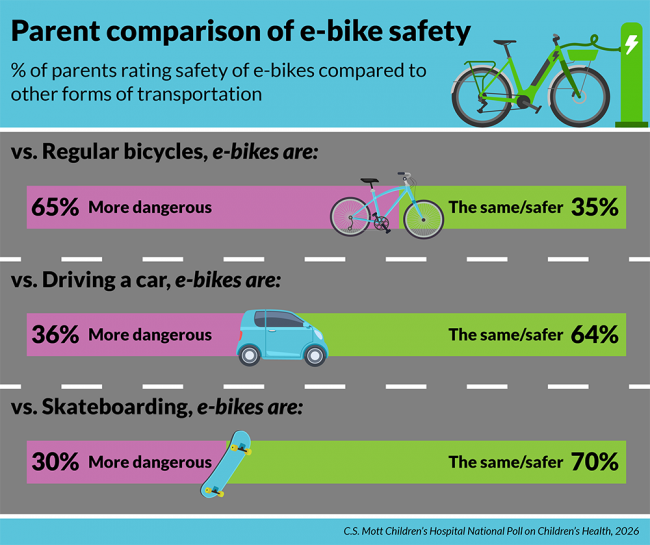
For a typical teen, 65% of parents rate e-bikes as more dangerous than regular bikes, while 3% think e-bikes are safer and 32% think they are about the same. However, only 36% of parents think e-bikes are more dangerous for teens than driving a car, 20% think e-bikes are safer, and 44% about the same. Compared to skateboarding, 30% of parents rate e-bikes as more dangerous, 24% as safer, and 46% about the same. Compared to off-roading/ATVs, 13% of parents say e-bikes are more dangerous, 37% think e-bikes are safer, and 50% about the same.
For their own community, parents strongly support helmet requirements (80%), labeling that shows the minimum age for different types of e-bikes (68%), clearer marking of where e-bikes should be ridden (63%), requiring age 18 for the most powerful e-bikes (59%), and required safety training (57%). Only 11% of parents strongly support a complete ban on e-bikes.
Highlights
- Most parents see benefits and risks of e-bikes for teens and pre-teens.
- Half of parents are unsure where e-bikes are supposed to be ridden.
- Parents strongly support helmet requirements, labeling of e-bike types, and better direction on where to ride.
- Only 1 in 10 parents support a ban on e-bikes.
Implications
E-bikes are becoming a more visible transportation and recreation option for children and teens. In many communities, e-bikes seem to be everywhere. Findings from this Mott Poll suggest that parents recognize several potential benefits for teens and pre-teens: about half see e-bikes as useful transportation when a car is not available or as a source of fun, while many also see them as a way to get kids outside and active or give teens more freedom in where they can go.
At the same time, parents acknowledge that e-bikes can pose safety risks for their child, both as an e-bike rider and as a pedestrian. Some risks are related to e-bikes themselves: the ability to travel faster means that riders have less time to react to hazards such as a turning car or a pedestrian stepping out into the road. Other risks are related to choices that e-bike riders (or their parents) make, such as using an e-bike that is too heavy and/or tall for the rider or not wearing a helmet. Unsafe riding practices, such as weaving in and out of traffic or riding too close to pedestrians, also contribute to the risk of injury.
This Mott Poll sheds light on how parents view e-bikes for teens, compared to other transportation or recreational options. Most parents rate e-bikes as about as safe or safer than teens driving a car, skateboarding, or riding an ATV or other off-road vehicle. This suggests that many parents do not view e-bikes as uniquely dangerous, but as another activity where safety depends in part on how and where they are used.
One challenge highlighted by this Mott Poll is that many parents may not know enough about e-bikes to make informed decisions about their child’s use. Only 6% of parents describe themselves as very informed about the different types of e-bikes, while two-thirds say they are not informed. One useful starting point is understanding the three-class system. Class 1 e-bikes provide motor assistance only while the rider is pedaling, up to 20 miles per hour. Class 2 e-bikes can use a throttle to propel the bike without pedaling, also up to 20 miles per hour. Class 3 e-bikes provide assistance while pedaling up to 28 miles per hour. These differences are meaningful because the power mechanism and the maximum assisted speed affect the level of skill and judgement needed to ride safely. Some states or communities have minimum age requirements for different classes of e-bikes; however, meeting the age requirement does not necessarily mean a child is ready to ride an e-bike safely. Parents should consider their child’s experience, judgement, maturity, and ability to follow traffic and safety rules when deciding whether a particular e-bike is appropriate.
Another challenge for parents – and the general public – is the lack of clarity around where e-bikes should be ridden. This lack of clear guidance creates a safety risk for drivers, e-bike riders, and pedestrians. In some instances, publicity around accidents involving children and e-bikes leads to a focus on where e-bikes should not be ridden, without offering clear guidance on where they should go. Additionally, some of the safest options – such as dedicated bike lanes – are not widely available, leaving children to determine the next-best option.
Despite the challenges, only 1 in 10 parents want a ban on e-bikes. Instead, parents offer strong support for policies and regulations that could lead to safer and more appropriate use of e-bikes, such as helmet requirements, clearer markings of where e-bikes should be ridden, age restrictions, and safety training. In addition, parents play a key role in setting – and enforcing – clear, age-appropriate expectations for their child about speed, where and when they can ride, avoiding distractions such as texting or using headphones, and using lights or reflective gear when riding in the evening. These rules can be adjusted as the child gains experience and demonstrates safe riding habits. Together, these approaches could give families clearer information about which e-bikes are appropriate for teens and pre-teens, help e-bike riders understand where they belong, and preserve the transportation, recreation, and independence that many parents see as benefits of e-bikes.
Data Source & Methods
This report presents findings from a nationally representative household survey conducted exclusively by Ipsos Public Affairs, LLC (Ipsos) for C.S. Mott Children’s Hospital. The survey was administered in July 2026 to a randomly selected, stratified group of adults who were parents of at least one child age 0-18 years living in their household (n=2,027). Adults were selected from Ipsos’s web-enabled KnowledgePanel® that closely resembles the U.S. population. The sample was subsequently weighted to reflect population figures from the Census Bureau. The survey completion rate was 69% among panel members contacted to participate. This report is based on responses from1,234 parents with at least one child age 11-18. The margin of error for results presented in this report is ±1 to 3 percentage points.
Findings from the C.S. Mott Children’s Hospital National Poll on Children’s Health do not represent the opinions of the University of Michigan. The University of Michigan reserves all rights over this material.
Citation
Clark SJ, Beel L, Gebremariam A, Schultz SL, Woolford SJ. E-bikes: Unsafe or uncertain? C.S. Mott Children's Hospital National Poll on Children's Health, University of Michigan. Vol 50, Issue 2, September 2026. Available at: https://mottpoll.org/reports/e-bikes-unsafe-or-uncertain.
