
Helping young adults stay active


Helping young adults stay active
Being physically active is a key part to a healthy lifestyle. There is a concern that as children graduate from high school, they may have fewer opportunities for physical activity. The C.S. Mott Children’s Hospital National Poll on Children’s Health asked a national sample of parents about physical activity for their adult children age 18-25.
Parents describe their young adult child’s usual level of physical activity as 26% very active, 41% moderately active, 28% minimally active, and 5% inactive. Parents report their child’s physical activity includes working out with exercise equipment (43%), work-related activity (41%), cardio exercise (33%), outdoor activity (31%), active fun (17%), and organized sports (14%). Parents are more likely to report active fun and organized sports for adult children 18-20 years, and more likely to cite work-related activity for adult children 21-25 years.
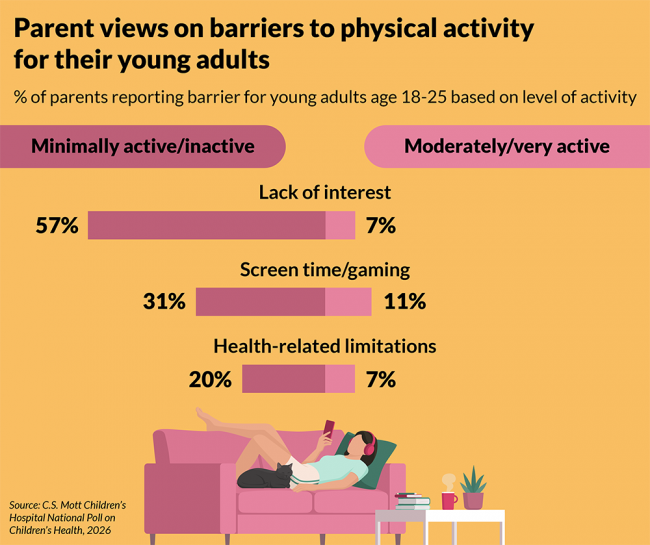
According to parents, things that get in the way of their adult child getting enough physical activity include time (36%), lack of interest (23%), screen time/gaming (17%), having no one to be active with (13%), cost (10%), and health-related limitations (11%). Parents who rate their adult child as minimally active/inactive, compared to moderately/very active, are more likely to cite lack of interest (57% vs 7%), screen time/gaming (31% vs 11%), and health-related limitations (20% vs 7%).
Parents have tried to encourage their child to be more physically active by giving them verbal encouragement (73%), suggesting options to try (61%), doing an activity with their child (50%), paying for an activity (27%), or offering a reward for being active (18%). Parents who rate their young adult child as minimally active/inactive, compared to moderately/very active, are more likely to say their efforts are not successful.
Parents who rate their young adult child as minimally active/inactive, compared to moderately/very active, are more likely to think that their adult child’s level of physical activity will cause health problems (69% vs 14%) or have a negative impact on their employment opportunities (17% vs 3%), and slightly more likely to report that a healthcare provider has talked with their adult child about their fitness or physical activity in the past two years (26% vs 21%).
Highlights
- 1 in 3 parents say their adult child is minimally active or inactive.
- 2 in 5 parents say lack of time gets in the way of their adult child getting enough physical activity.
- 3 in 4 parents have tried to encourage their adult child to be more physically active with verbal encouragement.
Implications
Physical activity has a profound impact on overall health, but many people do not maintain the same level of physical activity across the age span. Young adulthood can be a particularly challenging time. When youth are in high school, there are multiple options for physical activity through gym class and/or organized sports, and a structured schedule for those activities. After high school, young adults may need to put forth additional effort to find physical activity options they would enjoy, and to make time for physical activity.
A common challenge for young adults is how to maintain a healthy lifestyle as they become more independent and make their own choices. For some young adults, this means trying to fit exercise into their busy schedule or limited budget. Other young adults have enough time but have not incorporated physical activity into a routine. During this transition to independence, parents may play an important role in influencing their young adult children to maintain healthy levels of activity. This is particularly important, as habits established at this stage can impact their health trajectory over their lifetime.
Parents reported that young adults closer to high school were more likely to participate in organized sports and “active fun” such as dancing or skating, while 21 and older were more likely to engage in work related activity and time at the gym. This may represent a transition away from more social forms of activity to less interactive pursuits. Social connection offers enjoyment and has the potential of increasing the amount of time engaging in physical activity; thus, identifying ways to continue participation in group activities and active fun may improve levels of activity among young adults.
Parents in this Mott Poll described several ways in which they have tried to encourage their young adult child to be more physically active. One approach is to inform their child about the negative health impacts of insufficient activity; for young adults, who may not be focused on the long term, these warnings may have little impact. Moreover, if the parent is not active themselves, this advice may not come across as credible. A more positive approach may be for the parent to offer a “buddy strategy” of doing an activity together with their young adult child. This strategy allows both partners to keep each other accountable for regular engagement and offers a chance for conversation about the short-term positive effects of regular exercise, such as increased energy or improved mood.
One in three parents in this Mott Poll described their young adult child as minimally active or inactive, with many of these parents expressing concern that lack of activity will affect their child’s future health and employment opportunities. While parents of these young adults engaged in a range of efforts to encourage their children to be more active, they were often not successful. Parents felt that a key barrier is their child is not interested in physical activity; thus, finding activities that are fun and attractive is likely to be the key to increasing physical activity in young adults who currently are inactive. Parents also cited screen time as a barrier to physical activity. As screen time activities are designed to hold users’ attention, it may be difficult to encourage youth to replace that time with any type of exercise. However, active video games may represent a compromise for young adults to experience some of the benefits of exercise while still enjoying screen time.
Health care providers are another source of information and encouragement to help young adults maintain adequate levels of exercise. However, only about 1 in 4 parents reported that their young adult child’s physician addressed physical activity. This is a missed opportunity, especially for young adults who are minimally active and have health-related barriers to increasing their activity level. For this group, health care providers can help young adults identify activities that are helpful, not harmful, to their underlying conditions.
Data Source & Methods
This report presents findings from a nationally representative household survey conducted exclusively by Ipsos Public Affairs, LLC (Ipsos) for C.S. Mott Children’s Hospital. The survey was administered in February 2026 to a randomly selected, stratified group of adults who were parents of at least one child age 13-25 years living in their household (n=2,101). Adults were selected from Ipsos’s web-enabled KnowledgePanel® that closely resembles the U.S. population. The sample was subsequently weighted to reflect population figures from the Census Bureau. The survey completion rate was 69% among panel members contacted to participate. This report is based on responses from 1,550 parents with at least one adult child age 18-25. The margin of error for results presented in this report is ±1 to 5 percentage points.
Findings from the C.S. Mott Children’s Hospital National Poll on Children’s Health do not represent the opinions of the University of Michigan. The University of Michigan reserves all rights over this material.
Citation
Woolford SJ, Gebremariam A, Schultz SL, Clark SJ. Helping young adults stay active. C.S. Mott Children's Hospital National Poll on Children's Health, University of Michigan. Vol 49, Issue 2, April 2026. Available at: https://mottpoll.org/reports/helping-young-adults-stay-active.